
Artist Statement
I find inspiration in other people. Bodies are fascinating. How is it that the human form can be so drastically different from one person to the next? How can we trick the eye so that shapes and lines render a familiar face? The human body provides an endless source of inspiration for my art. I love the shapes of noses, rib bones, hearts, legs. How can I simplify? How can I exaggerate? Outside of portraits or figures, I find myself incorporating bodily elements into abstract works. I can’t seem to stay away from it. Most people have never seen an actual pair of lungs, but we can recognize their distinctive symmetrical shape in the most basic of line drawings, and that is the power of art on the mind.
My use of color is typically subjective, emotional, playful. I don’t want to just paint what I am seeing. I want to paint what I am feeling. Some of my recent portrait work seeks to blend the subject with their background, flattening them together by use of sameness of color and stroke, or the unfinished line that allows them to fade into each other.
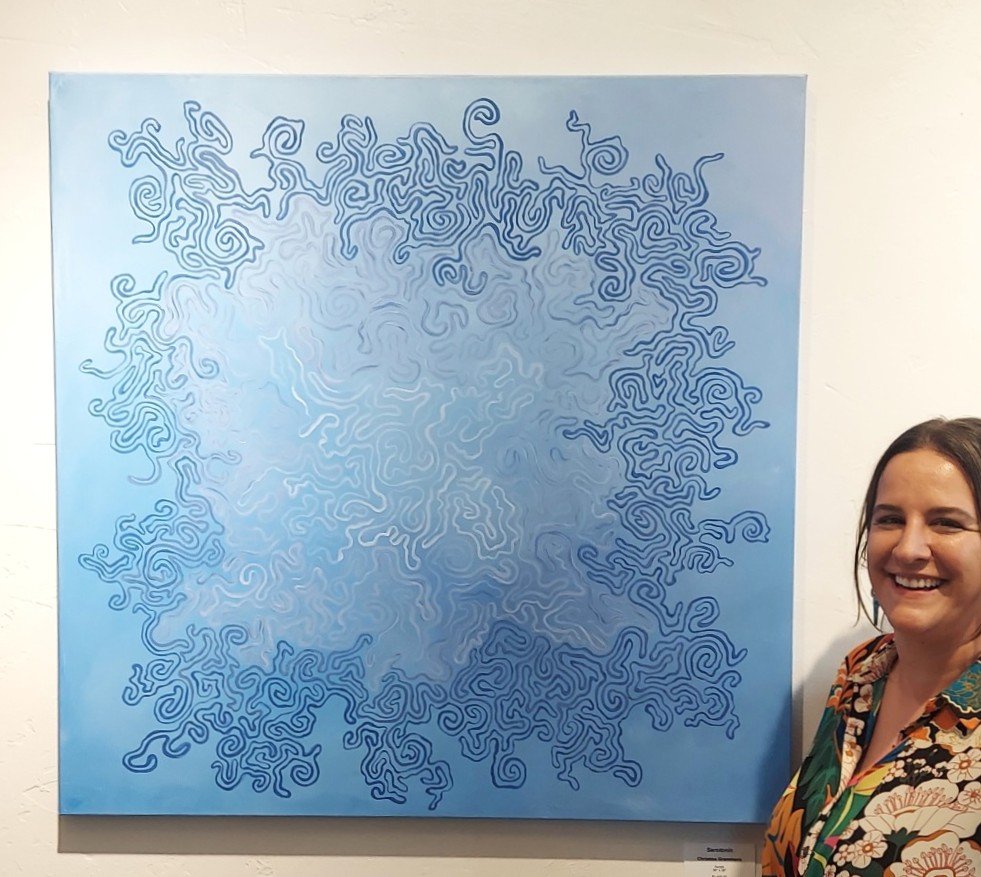
Lately, I have been exploring the idea of the brain as a maze, using line to represent the mind as a physical abstraction that resembles a labyrinth, but also in the metaphysical sense that our own mind is a place we can navigate, get lost in, a place of pathways we can revisit and—possibly change.
My maze series is developed around the idea of neuroplasticity, or the brain's ability to change and adapt. Sometimes we are stuck in thought patterns that we can't seem to break. Other times we have a moment of dramatic change that can alter our way of thinking. The mazes explore these repetitive patterns of the brain. Several larger works from my maze series are titled after chemicals that occur naturally in the brain. As I painted these, I attempted to create a representation of the chemicals moving through the brain, while trying to avoid a literal interpretation of it. The linework of the mazes is reminiscent of the physical qualities of the brain. While the brain uses electrical impulses to send information, the lines of color in the mazes can be interpreted as the information passing along the pathways in the brain. Once a pathway has been established in the brain, the brain and body naturally return to that same pathway quickly and efficiently. Changing a thought pattern requires taking the proverbial “road less travelled” through your brain.
grammensfineart@gmail.com
instagram @christina.grammens.art
Artist Bio
Christina Grammens lives in Gillette, Wyoming with her husband, children, and dogs. She is an avid reader and a second-rate baker. She is a follower of Christ.
Christina graduated from Chadron State College in Chadron, Nebraska with a Bachelor of Fine Arts in 2014, and completed her master’s degree in education from the University of Wyoming in 2019.